
A Squirrel Thinks I’m a Dangerous Nut
Plus: Al Capone, Tony Bennett, Frank Sinatra, and playing chess with Death

I’m sitting in my back yard, enjoying the nice morning tapping away on my laptop, and a squirrel is giving me the side eye. He has paused on top of my wall, a small orange in his teeth. He is wondering what to do if I make a move. Does he have a reason to fear me? Should he scurry away? Am I after his orange? (It strikes me that a lot of people think these same thoughts today walking along the streets of any major city.)
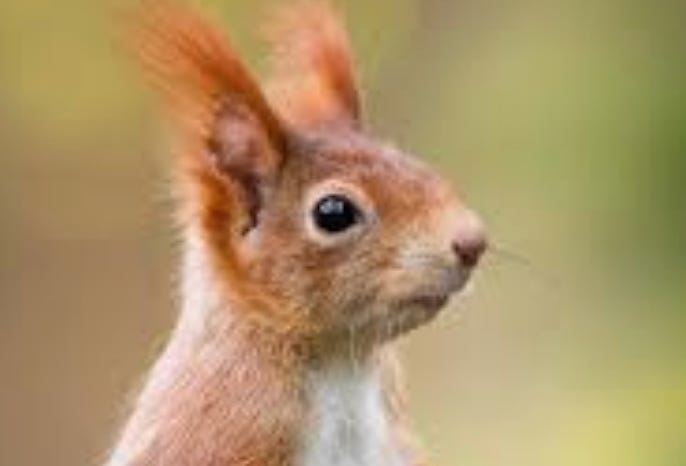
Ah, he has just decided to move on, into the welcoming concealment of the rich foliage surrounding my property. I hope he finds a safe place to stow his treasure. He has enough problems around here. There are dogs, coyotes, feral cats, and at least one dedicated hawk that likes to circle around above my home. No wonder the squirrel is nervous. But why should he be anxious about me, who means him no harm?
Robert Burns asked the same question in his poem, “To a Mouse: On Turning her up in her Nest with the Plough, November 1785.” Writing in a Scottish brogue, he begins:
Wee, sleeket, cowran, tim’rous beastie,
O, what a panic’s in thy breastie!
Thou need na start awa sae hasty,
Wi’ bickerin brattle!
I wad be laith to rin an’ chase thee
Wi’ murd’ring pattle!
Thanks to the Robert Burns Federation, here’s the translation:
Small, sleek, cowering, timorous beast,
O, what a panic’s in your breast!
You need not start away so hasty
With hurrying scamper!
I would be loath to run and chase you,
With murdering plough-staff.
Verse 2:
I’m truly sorry Man’s dominion
Has broken Nature’s social union,
An’ justifies that ill opinion,
Which makes thee startle,
At me, thy poor, earth-born companion,
An’ fellow-mortal!
Burns goes on to empathize with the mouse, especially since “the best laid schemes o’ mice an’ men / Gang aft agley” (Go often askew).
What a pain it is to panic. It puts a real damper on your day. But throughout history that was the daily reality for humankind, because there were always tribes out there who wanted to kill your tribe and take all your stuff.
In the 13th and 14th centuries, the Mongols induced a state of panic all across the Eurasian Steppe, a 5,000-mile grassland between Eastern Europe and Manchuria. By the time they finished their campaigns, Genghis Khan (1158–1227) ruled over roughly one‐sixth of the world’s land surface.
The Mongols were not subtle about this. They killed millions of people and destroyed dozens of the greatest cities of the ancient world. But hey, you don’t make omelets without breaking some eggs, am I right? They also set up trade routes between east and west, which enabled Italian explorer Marco Polo (1254–1324) to make his famous journey along the “Silk Road” into the heart of China, where he taught Kubla Khan a swimming pool game.
Games are a substitute for war. It would be nice if wars were decided by two guys, one from each side, playing a game of darts or checkers or Super Mario. In Ingmar Bergman’s classic movie, The Seventh Seal, the protagonist plays a game of chess with Death.
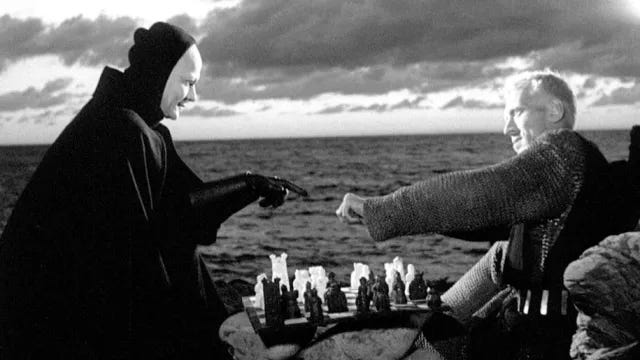
The symbolism is obvious. We all “play” the game of life, and we must learn the best moves to make, especially when we find ourselves in a challenging position, like being pulled over by a cop or having your wife ask, “Does this dress make me look fat?”
